"100% pure PC" has become one of the most used phrases in hardside luggage marketing. It sounds like a guarantee: the purer the material, the better the case. During my years in travel-goods manufacturing, I have learned to read that claim carefully — because the truth about shell performance is more interesting, and more useful, than the label.
Polycarbonate is genuinely an excellent material for luggage. It is valued for its high impact resistance, its ductility, and its ability to deform without immediate fracture — a shell that flexes and recovers instead of cracking. These characteristics have made it one of the most important materials in modern hardside luggage, and nothing in this article argues against it.
But material purity alone does not determine finished-product performance. A properly engineered PC/ABS alloy can provide a useful balance of impact toughness, low-temperature performance, dimensional stability, processability and cost. In certain formulations, the elastomeric phase within ABS improves energy absorption and resistance to crack propagation around notches — and research has identified particular PC/ABS ratios at which the blend shows synergistic impact performance.
This does not establish that PC/ABS is universally tougher than pure PC. It establishes something more important: the blend's performance depends on how well it is engineered.
What actually decides a PC/ABS sheet's performance
A PC/ABS alloy is not one material — it is a family of them. Its performance depends on several closely connected variables:
- PC molecular weight and viscosity
- PC-to-ABS ratio
- Rubber-particle size and distribution
- Phase morphology and interfacial compatibility
- Compatibilizer and impact-modifier selection
- Extrusion temperature and shear history
- Moisture control
- Recycled-material content and thermal history
Why blended sheets earned a bad reputation
The suspicion many buyers hold against PC/ABS is not irrational — it comes from history. Earlier generations of low-cost mixed sheets often suffered from inadequate control of exactly those variables. Poor dispersion, unstable compatibility and repeated reprocessing could produce inconsistent sheet properties. Some materials performed adequately when new but became brittle or unstable after heat ageing and prolonged storage.
Those experiences built the perception that blended material was inherently inferior to pure PC. That conclusion is no longer technically sufficient. Advances in polymer modification, compatibilization, extrusion control and recycled-material management have allowed manufacturers to produce substantially more stable PC/ABS alloy sheets — and they are now common in the mid-market segment, whether or not the product label admits it.
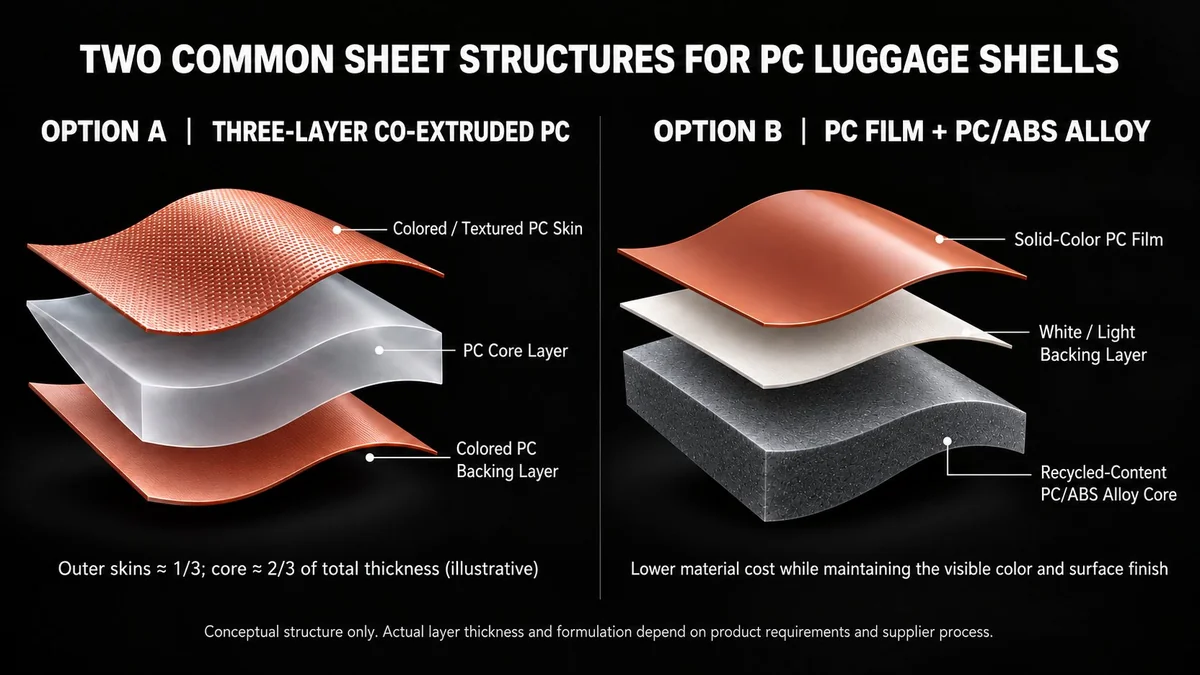
The cost-optimized construction you rarely hear about
One widely used cost-optimized luggage-sheet construction consists of three layers:
- a solid-colour PC surface film, which supplies the visible colour, finish and texture;
- a white or light-coloured backing layer, which supports opacity and appearance;
- a thicker PC/ABS alloy core containing controlled recycled content, which provides most of the thickness and structural contribution at a lower material cost.
Such constructions are frequently encountered in the mid-market luggage segment, although the product may still be described commercially as "PC luggage." That description is not technically complete — but that is not the point that matters.
The question worth asking instead
The more useful question is not whether the purity claim is complete. It is whether the selected construction delivers reliable performance throughout the intended product life.
Both failure and success remain possible on either side of the purity line:
- A poorly dried or poorly processed virgin-PC sheet can fail.
- A carefully formulated and validated PC/ABS alloy sheet can perform very well.
Material evaluation should therefore extend beyond a purity claim and consider formulation control, thermal history, ageing resistance and finished-shell testing. "100% pure PC" is an understandable consumer message. It is not, by itself, a complete engineering specification.
The best material is not always the purest material. It is the material system that delivers the most appropriate balance of performance, durability, manufacturability and cost.
Frequently asked: PC purity vs PC/ABS alloy
Choosing a shell construction for your next product?
Send us your target price point and use case. We will walk through the sheet options — pure PC, co-extruded PC and PC/ABS alloy constructions — and show what each would change in your specification, test plan and landed cost. Whether or not it turns into a project, you keep the answer.
Start a Conversation →