A founder developing a luggage or bag brand can find potential suppliers within minutes.
Factory websites, sourcing platforms and social media offer an abundance of options. Many make similar promises: premium quality, competitive pricing, flexible customization and reliable delivery.
Yet a long supplier list often leaves the most important questions unanswered.
Will the new feature work reliably? Will production match the approved sample? Can the product stay within budget without losing the details that make it worth buying? Will it arrive when the business needs it?
These outcomes depend on more than a factory's willingness to accept an order. They depend on its people, technical capabilities, management systems and fit with the project.
What the founder is actually buying
A founder may describe the requirement as a custom suitcase, a waterproof backpack or a new travel bag.
Behind that request is a set of expectations:
- The product performs as intended.
- Distinctive features survive development and repeated use.
- Costs remain within an agreed commercial framework.
- Materials, construction and finishing meet defined requirements.
- Changes and production problems are identified early enough to act.
- Delivery follows a realistic, agreed schedule.
A catalogue cannot establish whether a supplier can meet those expectations.
Some capabilities become visible only through technical discussions, sample development, process review and production records. Others depend on how the factory responds when something goes wrong.
The sourcing task is therefore broader than finding someone who can make a similar-looking product.
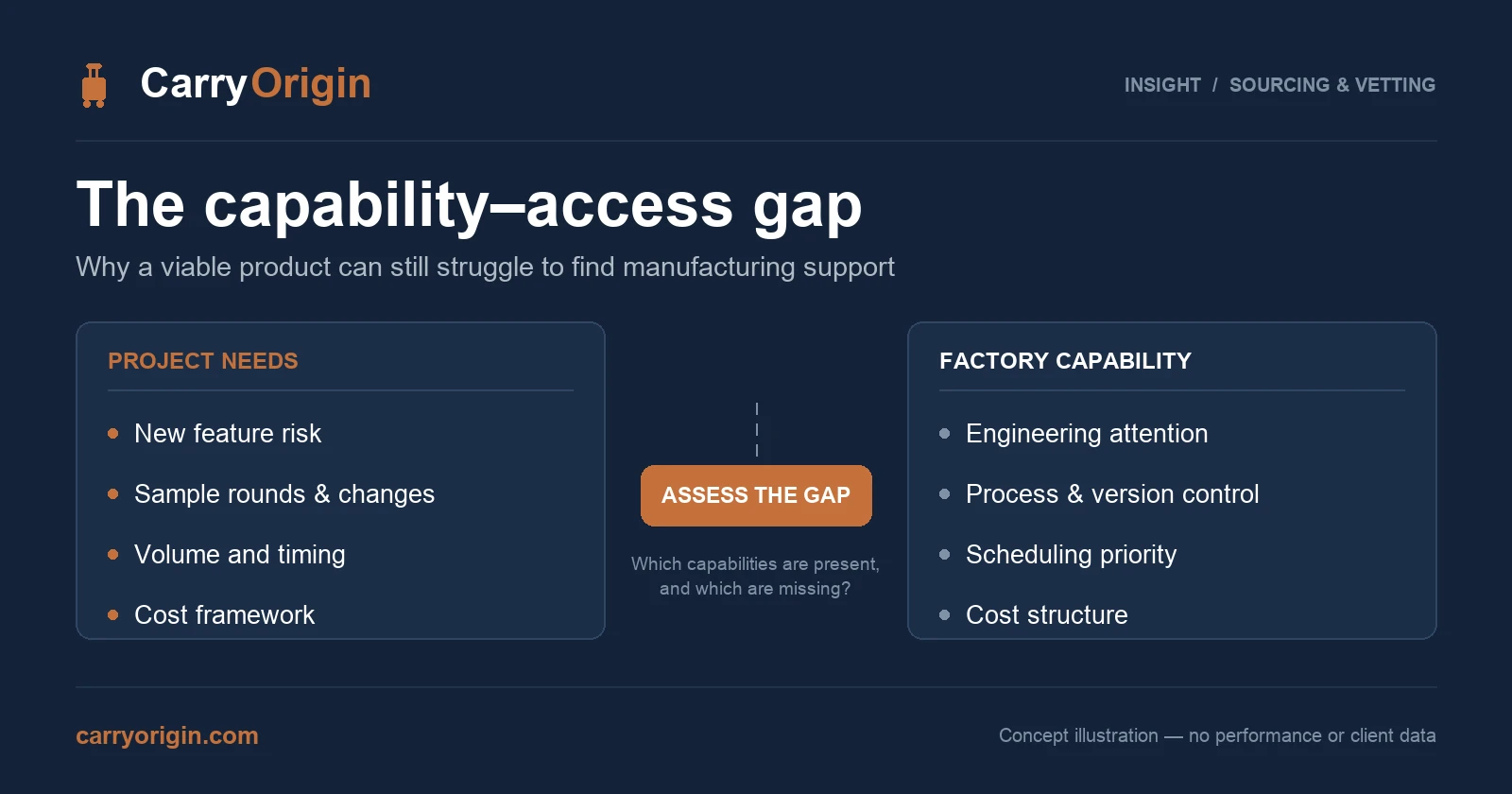
The capability–access gap
Factories with experienced technical teams and well-developed management systems can be attractive partners. They may have stronger development controls, more consistent processes and greater familiarity with demanding customers.
But they may also be organized around established brands and larger production programmes.
A startup's order can require substantial engineering attention, multiple sample rounds and unfamiliar components while offering limited initial volume. Even a promising concept may be difficult to accommodate within the factory's commercial priorities.
The obstacle is not always price. It may be the allocation of development resources, material purchasing requirements, production scheduling or uncertainty about repeat business.
A founder can have a viable market opportunity and still struggle to secure the manufacturing support needed to pursue it.
Flexibility brings a different set of questions
Smaller suppliers may offer a more accessible starting point: closer owner involvement, smaller production runs or greater willingness to explore an unconventional idea.
Some also possess excellent specialist expertise.
Size alone is a poor measure of capability. A focused workshop may be highly skilled in a particular construction, while a large factory may be poorly suited to that same product.
The question is which capabilities are present and which are missing.
A flexible supplier might have strong craftsmanship but limited version control. Another might produce a good sample yet struggle to maintain material consistency. A third may understand conventional products well but need support interpreting a new mechanism or an unfamiliar use case.
These gaps do not automatically disqualify a supplier. They do require an explicit response.
Translate the idea before asking the factory to deliver it
Founders often understand the customer and the market opportunity more clearly than the manufacturing process.
That knowledge is essential, but it needs translation.
“Quiet wheels” must become requirements that can be evaluated under defined conditions. “Waterproof” needs a stated use case and an appropriate validation approach. “Premium finishing” needs agreed references and acceptance criteria.
Without that translation, the founder and the factory can believe they have reached agreement while imagining different products.
A useful development brief connects the customer promise to:
- Product functions and intended use;
- Materials, components and construction;
- Measurable requirements where appropriate;
- Visual and tactile references;
- Testing and acceptance conditions;
- Cost, quantity and timing constraints.
Not everything will be settled at the beginning. Unresolved questions should be recorded, assigned and scheduled for a decision.
Build a strategy around the actual capability gap
A tailored supply chain strategy starts with the product's risks and the supplier's ability to control them.
With an established factory, the work may involve making the programme easier to evaluate and support: presenting a coherent brief, limiting unnecessary variation, agreeing on paid development and setting realistic approval dates.
With a smaller supplier, the work may involve strengthening specific parts of the process:
- Converting informal requirements into controlled specifications;
- Reviewing samples against documented criteria;
- Confirming critical material and component choices;
- Planning targeted validation before irreversible commitments;
- Establishing production checkpoints;
- Recording changes and verifying corrective actions.
The support should match the risk. A conventional product using proven construction needs a different level of intervention from a new structure with an untested function.
Some gaps are also too substantial to close within the available budget or schedule. Additional coordination cannot substitute for missing technical capability, unsuitable equipment or an unwillingness to disclose problems.
In those circumstances, the appropriate decision may be to change the supplier, simplify the design or revise the programme.
Put the cost of support into the budget
A low MOQ can make a project possible. It does not, by itself, make the project economical.
Compare the full cost of the available routes, including development, tooling, testing, coordination, inspection and foreseeable rework—not just the quoted unit price.
If a lower-priced supplier needs additional technical and management support, that work should be budgeted from the start. Otherwise, the apparent saving may be absorbed by repeated sampling, production corrections or delayed delivery.
A smaller supplier with well-targeted support may still be the right choice. The decision should reflect the combined cost and risk of delivering an acceptable product.
Make trust visible through the work
Personal relationships can help identify candidates and open conversations. Experience helps determine which questions to ask.
Neither removes the need for project-specific evidence.
A clear working process makes the basis for trust visible. The client should be able to understand:
- What has been agreed;
- Which claims have been verified;
- What remains uncertain;
- Who owns each action and decision;
- What must happen before the next stage is approved.
Choosing a supplier for sampling, approving a design for tooling and releasing a production order are separate decisions. Each requires its own evidence.
This structure also supports the factory. Clear requirements, timely approvals and controlled changes reduce uncertainty on both sides.
A workable partnership, built deliberately
The right supplier is not necessarily the largest factory, the lowest quotation or the most familiar introduction.
It is a supplier whose capabilities and commercial priorities fit the project—and whose remaining gaps can be addressed at an acceptable cost and level of risk.
For a DTC founder, that assessment can be difficult to make alone. The value of experienced supply chain support lies in translating the product vision, examining the evidence and organizing the work needed to move forward.
At CarryOrigin, that is the basis of our approach: connect product requirements with manufacturing capability, make decisions traceable and keep unresolved risks visible.
If you have a product concept, a sample or a supplier shortlist, the useful next question is: what needs to be established before you commit further?
Discuss your project with CarryOrigin
Related: The Luggage Sourcing Playbook