Over a career in travel-goods manufacturing, I have noticed something uncomfortable about the worst quality failures. Very few of them were mainly caused by workers lacking skill, or by a factory using poor workmanship. The real problem usually started much earlier — a potential failure mode that nobody identified during development.
A wheel housing was never designed for the real impact load. A zipper or seam was never evaluated under overpacking conditions. A backpack shoulder strap passed its pull test, but the load path through all the material layers was never fully understood. The product looked good, passed inspection and even completed the normal laboratory tests. Then mass production or market use exposed a weakness nobody had considered.
This is exactly what FMEA exists to prevent — and yet in the travel-goods industry it remains surprisingly rare as a routine practice. This article explains what DFMEA and PFMEA actually ask, why our industry has not embedded them, and how a luggage factory can start without copying automotive complexity.
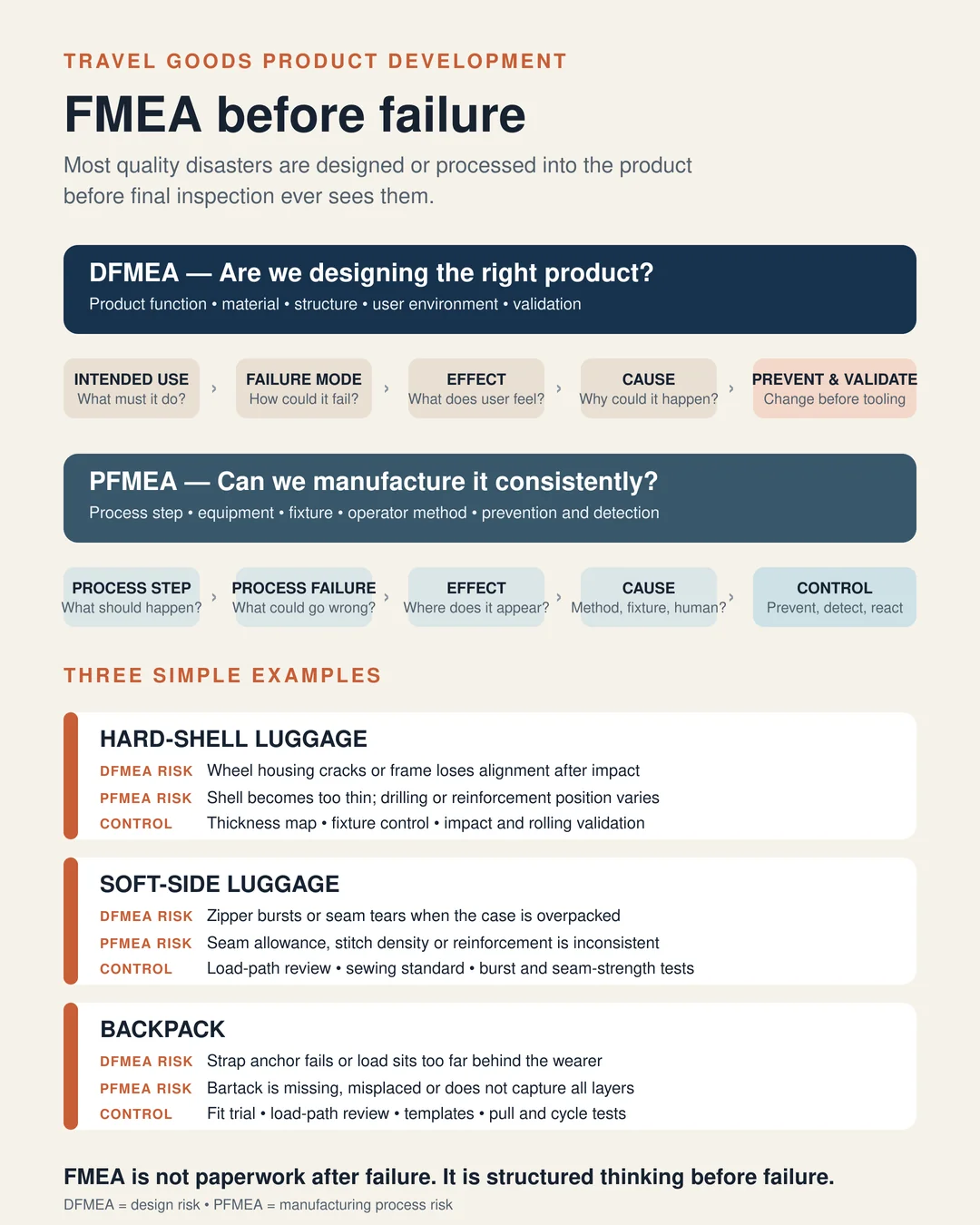
What FMEA actually asks
FMEA — Failure Mode and Effects Analysis — comes in two flavours that map cleanly onto our industry.
DFMEA asks questions about the product design:
- What must the product do?
- How could that function fail?
- What would the customer experience?
- What design or material condition could cause it?
- How can we prevent or validate the risk before tooling?
PFMEA asks the same questions about manufacturing:
- What should happen at this process step?
- What could go wrong?
- What would the failure affect?
- Could it come from the method, the machine, the fixture, the material or the operator?
- How do we prevent it, detect it, and react if it happens?
Neither exercise is a form to complete. Both are a habit of interrogating the product and the process before the failure has a chance to happen — and turning the answers into specifications, validation tests and process controls.
Why the industry has not embedded it
The travel-goods industry is not short of experience. It has many engineers, developers and factory managers who already think about individual risks — based on decades of pattern recognition. That experience is real, and it catches real problems every day.
What experience alone does not do is make the thinking systematic, documented and transferable. In most factories FMEA appears only in isolated projects — usually when a customer demands it or after a costly failure. It is rarely embedded as a routine, cross-functional process that runs from product definition through development, pilot production and mass production. The experienced person keeps the risk knowledge in their head; when they are unavailable, the risks quietly reintroduce themselves.
That gap is the opportunity.
Start with one product, one page, ten risks
A luggage factory does not need to copy the full complexity of an automotive FMEA system on day one. The practical entry point is deliberately small: one product, one page, the ten most important risks.
For a hard-shell suitcase, those usually include shell thinning, wheel-housing failure and frame misalignment. For soft luggage: zipper bursting, seam tearing, or missing reinforcement. For a backpack: shoulder-strap attachment, bartack position, and the way the load sits against the wearer.
| Product | Typical DFMEA risk | Typical PFMEA risk | Controls that follow |
|---|---|---|---|
| Hard-shell luggage | Wheel housing cracks or frame loses alignment after impact | Shell becomes too thin; drilling or reinforcement position varies | Thickness map · fixture control · impact and rolling validation |
| Soft-side luggage | Zipper bursts or seam tears when overpacked | Seam allowance, stitch density or reinforcement inconsistent | Load-path review · sewing standard · burst and seam-strength tests |
| Backpack | Strap anchor fails or load sits too far behind the wearer | Bartack missing, misplaced, or not capturing all layers | Fit trial · load-path review · templates · pull and cycle tests |
The part that actually matters
Here is the honest caveat: the completed FMEA page itself is not the deliverable. A form that is filled in and filed is paperwork after failure — just filed earlier.
The value comes from what the results change:
- a risk that was only an opinion becomes a product specification;
- a "probably fine" becomes a validation test in the laboratory plan;
- a process dependence becomes a process control with a reaction plan;
- every closed case becomes a lesson fed back into the next development.
When that loop runs, the same thinking that prevents failures also shortens development — because fewer surprises surface at pilot-run, and the pilot-run itself becomes confirmation rather than discovery.
Frequently asked: FMEA in luggage development
Want a first-pass FMEA on a product you are developing?
Send us the product sketch or the spec you are planning. We will walk the ten most important risks for that category with you — design and process — and show what each one would change in your specifications and test plan. Whether or not it turns into a project, you keep the answer.
Start a Conversation →