A quality issue is not closed when the rework is finished. It is closed when corrective actions have been verified—and the problem does not return during the agreed follow-up period.
In a factory improvement project I supported, this distinction became central to reducing internal failure costs. Recording rework and scrap made the losses visible. Strengthening how the factory investigated, corrected and followed up on quality problems helped turn those records into improvement.
The result
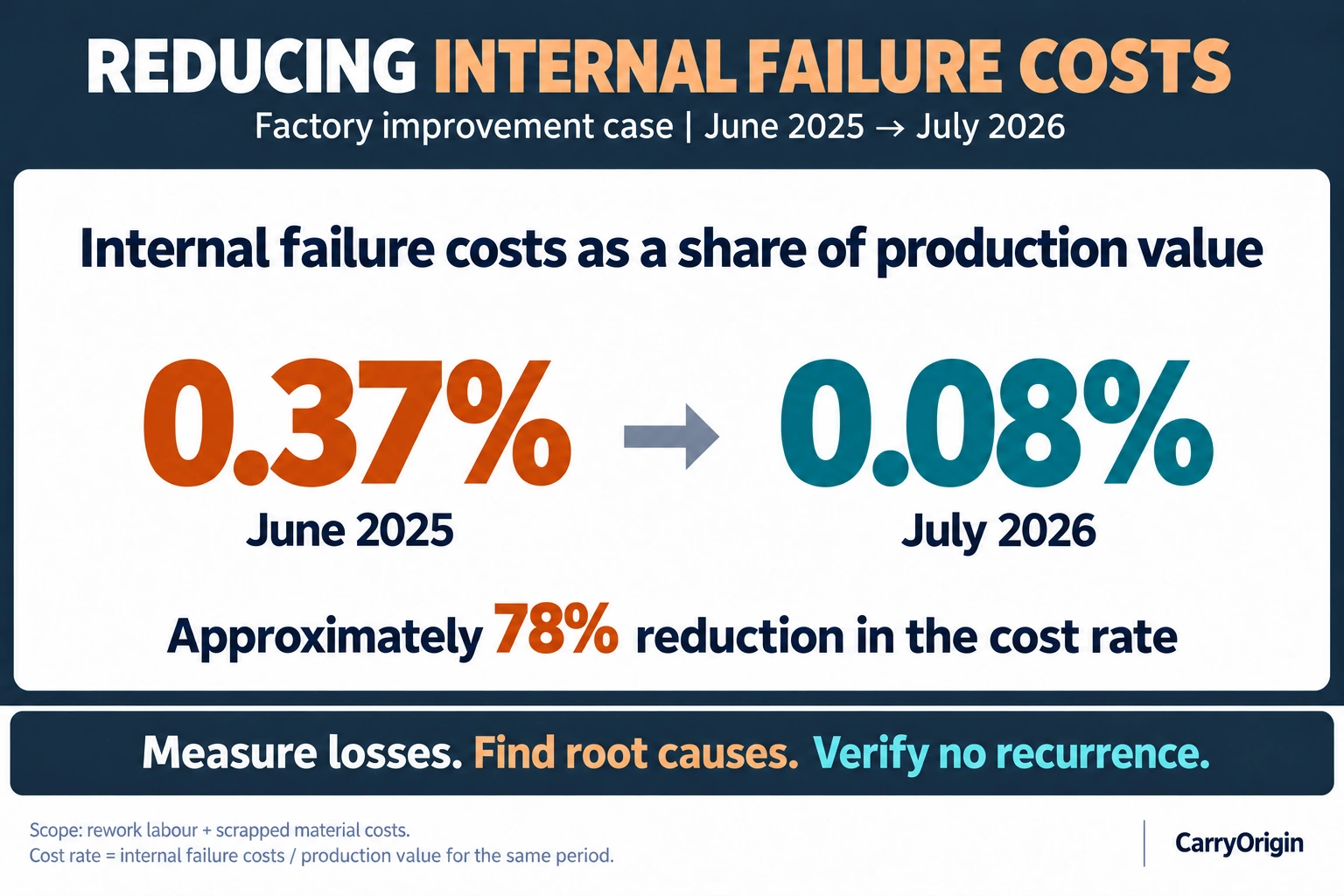
Recorded internal failure costs decreased from 0.37% of production value in June 2025 to 0.08% in July 2026—an approximately 78% relative reduction in the cost rate.
The measure covered rework labour and the material cost of scrap, using production value for the same period as the denominator.
1. Establish a practical baseline
We began by bringing process rework and scrap into a consistent reporting method. The aim was to understand where losses were occurring without making routine data collection unnecessarily complicated.
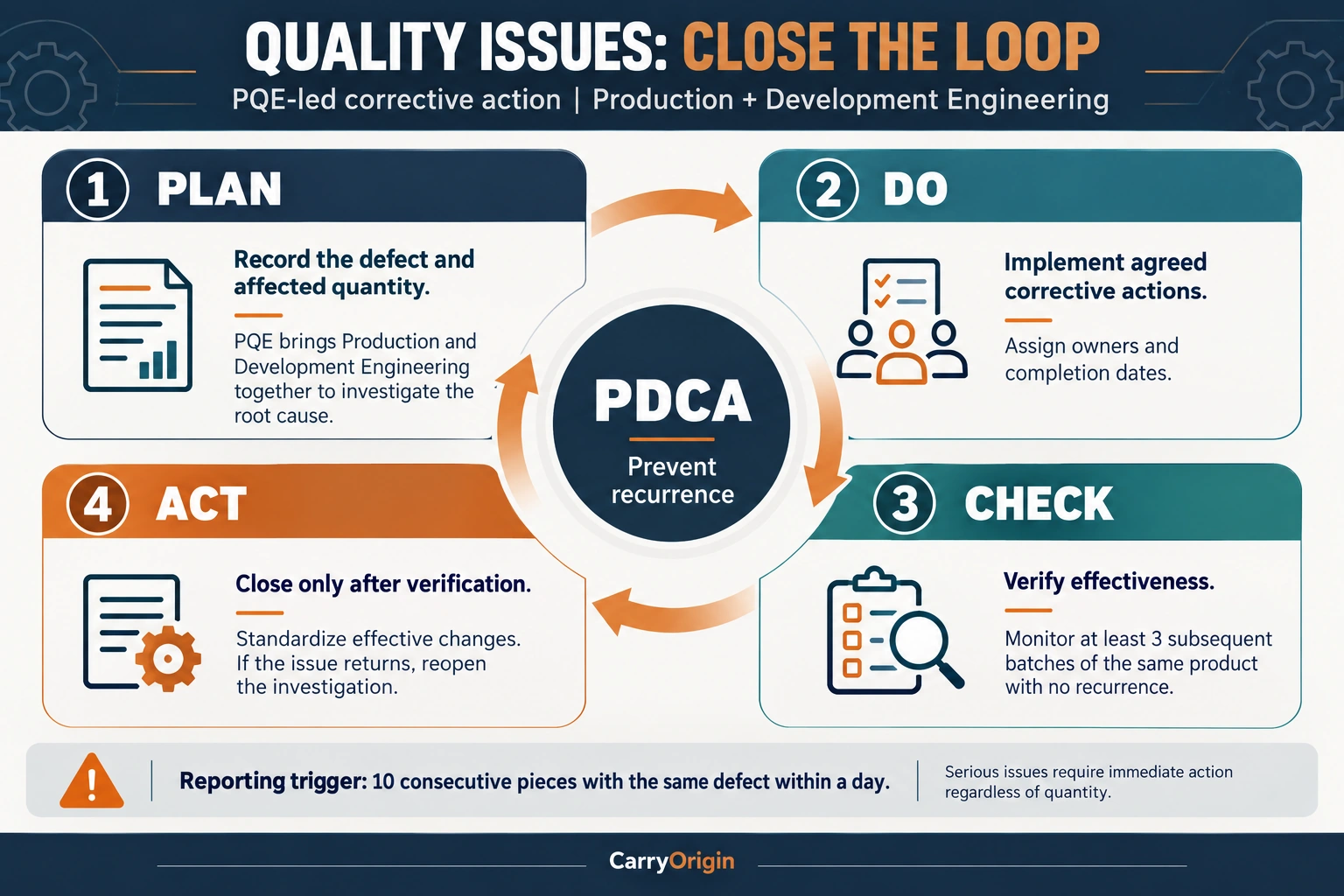
We set a clear trigger: finding 10 consecutive pieces with the same defect within a day required a batch-level quality exception report. The team then recorded the total affected quantity, rather than stopping at the first 10 pieces.
This was a reporting and escalation threshold, not an acceptable defect allowance. Serious issues still required immediate action regardless of quantity.
2. Translate defects into internal failure costs
Counting defective pieces alone does not show their business impact. A defect that takes a few minutes to repair creates a different loss from one that requires extensive dismantling or makes a component unusable.
Our defined cost measure therefore used:
- Rework labour cost: rework hours multiplied by the applicable labour cost per hour.
- Scrap material cost: the material cost of the items scrapped.
The internal failure cost rate was calculated as recorded internal failure costs divided by production value for the same period. Consistent recording and valuation were necessary to make the comparison meaningful.
This was a defined measure of direct rework and scrap losses, rather than the full cost of poor quality. It did not attempt to capture every possible consequence, such as disrupted capacity, delayed delivery or customer claims.
3. Make root-cause investigation a shared responsibility
The most important management change was how each reported exception was handled. The PQE—the process quality engineer—had to bring together the production owner and development engineer to investigate the cause and agree on corrective actions.
Production understood what was happening on the line. Development engineering could examine construction, specifications and manufacturability. The PQE coordinated the investigation and follow-up.
The discussion could not stop at “remind the operators” or “increase inspection.” The team needed to determine what had to change in the product, process, materials or work method, then assign responsibility for implementation.
Rework dealt with the affected goods. Corrective action needed to address the reason those goods became defective.
4. Verify effectiveness before closing the report
A completed action was not, by itself, sufficient evidence that the problem had been solved.
After verifying the corrective action, we continued following subsequent production. An exception could only be closed after at least three subsequent batches of the same product showed no recurrence.
That closure rule kept the investigation connected to actual production. If the defect returned, the team needed to revisit its explanation and actions, rather than treating the earlier report as proof that the problem was already resolved.
What the improvement demonstrates
The cost rate fell from 0.37% in June 2025 to 0.08% in July 2026. The relative reduction was approximately 78%; the change was 0.29 percentage points.
Those two figures describe the outcome of this improvement project. They do not isolate the contribution of every individual action, or establish that all factories will achieve the same result.
For me, the practical lesson is that cost tracking makes losses visible, while shared ownership and sustained verification help prevent those losses from returning.
Completing rework resolves the affected batch. Preventing recurrence builds the factory’s capability.