A luggage wheel should be evaluated as a complete assembly—under load, on the case, and through the handle.
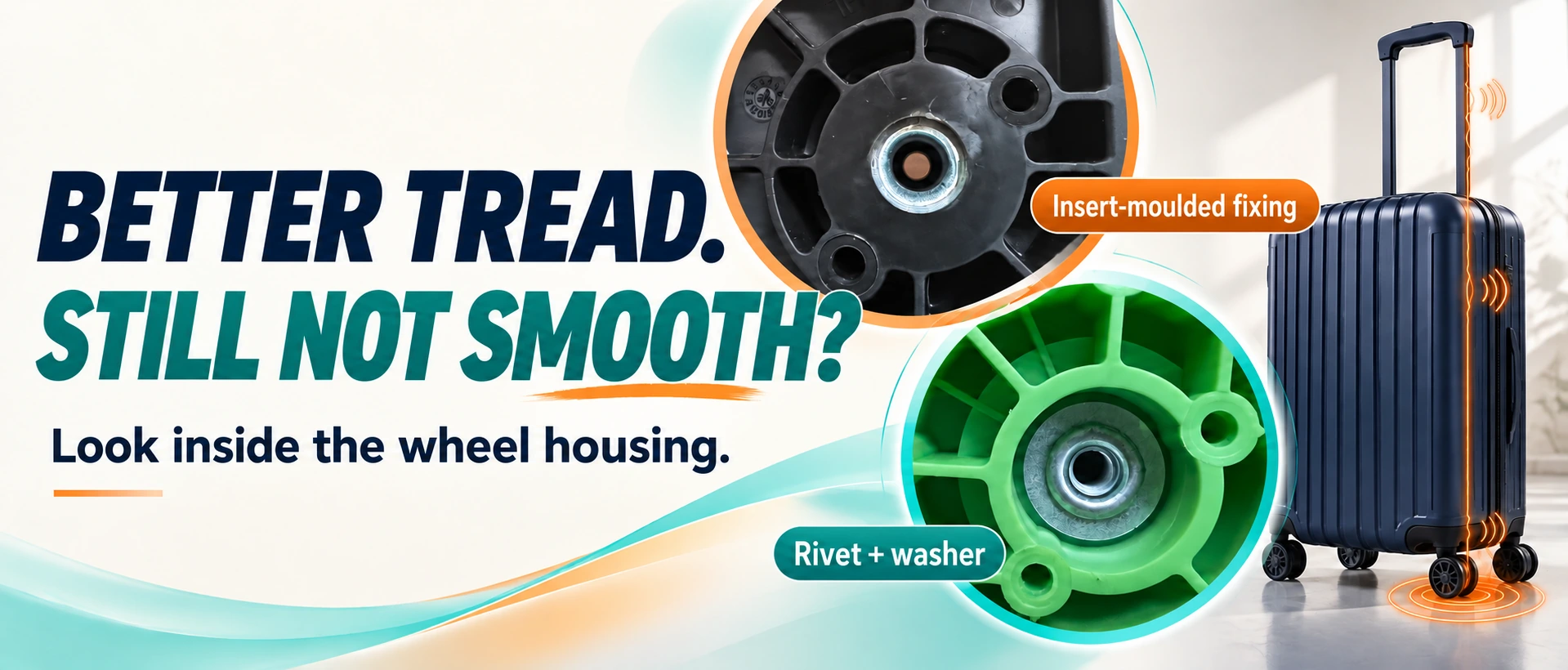
When a suitcase does not roll smoothly, the first suspect is often the wheel’s outer tread. The response is familiar: upgrade the material, adjust the hardness and accept a higher component cost.
Yet a more expensive tread does not necessarily remove the fine vibration the customer feels through the trolley handle.
In comparisons across several wheel suppliers, I encountered this repeatedly. Some alternatives cost more than the Hinomoto assemblies used as a benchmark, but still produced a noticeably less settled feel when the suitcase was pushed upright. That led me to look beyond the tread and into the wheel housing.
The short version
- Tread material is only one contributor to the rolling experience.
- Diameter variation alone cannot rule out geometry or runout problems.
- Housing stability and connection fit deserve investigation.
- Compare complete wheel sets on a loaded suitcase under consistent conditions.
The key distinction: rolling easily and rolling smoothly
A suitcase can move with relatively little effort while still transmitting small, repeated disturbances to the hand. These are different aspects of performance.
The customer experiences the combined behaviour of the tread, wheel core, axle, swivel assembly, housing, case mounting and trolley handle. Improving one part may leave the main source of disturbance unchanged.
The right development question is therefore: which part of the assembly is limiting the experience?
What the dimensional checks showed—and what they did not
To investigate a possible geometry issue, we measured 50 wheels, taking diameter readings at six positions on each wheel. The observed variation was approximately 0.2–0.5 mm.
Those readings provided useful screening information. However, they did not establish that geometry had no meaningful influence.
A range of diameter measurements is not a complete roundness assessment. It also does not directly measure radial runout relative to the actual rotation axis. A finished wheel can have similar measured diameters while still rotating eccentrically.
The distinction between the moulded core and the finished, overmoulded wheel matters too. A satisfactory core does not automatically establish the geometry of the final rolling surface.
For that reason, I would retain checks on finished-wheel geometry and assembled runout while investigating the housing. The measurements helped direct the investigation; they did not close it.
A difference inside the housing
Two housing samples showed a construction difference worth examining. In the black Hinomoto sample, the metal fixing element was embedded in the moulded plastic structure. The green comparison sample used a rivet-and-washer arrangement.
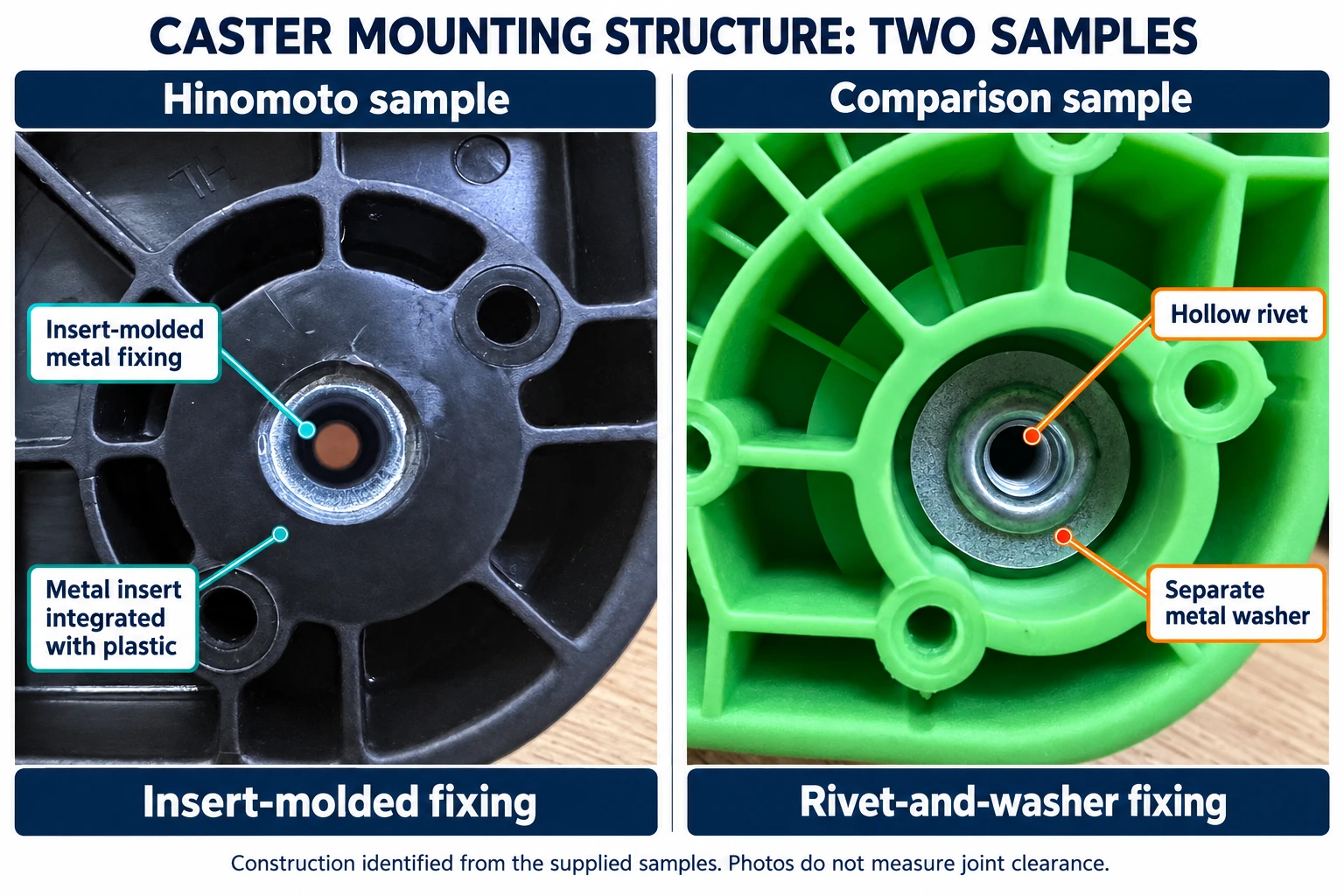
Across the samples I compared, the connection’s fit, retention and small movements under load became an important area of investigation.
A connection that permits unwanted axial movement or rocking may affect how consistently the wheel assembly supports and follows the case. Those movements could contribute to disturbances transmitted through the luggage structure.
However, the construction difference alone does not prove the cause. The two assemblies may also differ in bearing behaviour, geometry, alignment, stiffness and manufacturing tolerances. A controlled comparison is needed to isolate their contributions.
The observation identifies a plausible mechanism to test. It does not establish that every riveted design is inferior to every moulded-in design.
The engineering requirement is stable, repeatable performance under load, achieved through suitable design and process control.
Why the handle is part of the test
Hold the suitcase upright, with all four wheels on the floor, and push it forward using the trolley grip. This is a useful condition because the hand receives feedback through the complete product.
A disturbance may originate at the rolling surface, within a wheel assembly or at its attachment to the case. The case and trolley system then influence how that disturbance reaches the user.
What the customer notices may be a fine, continuous tremor rather than obvious bouncing or loud noise.
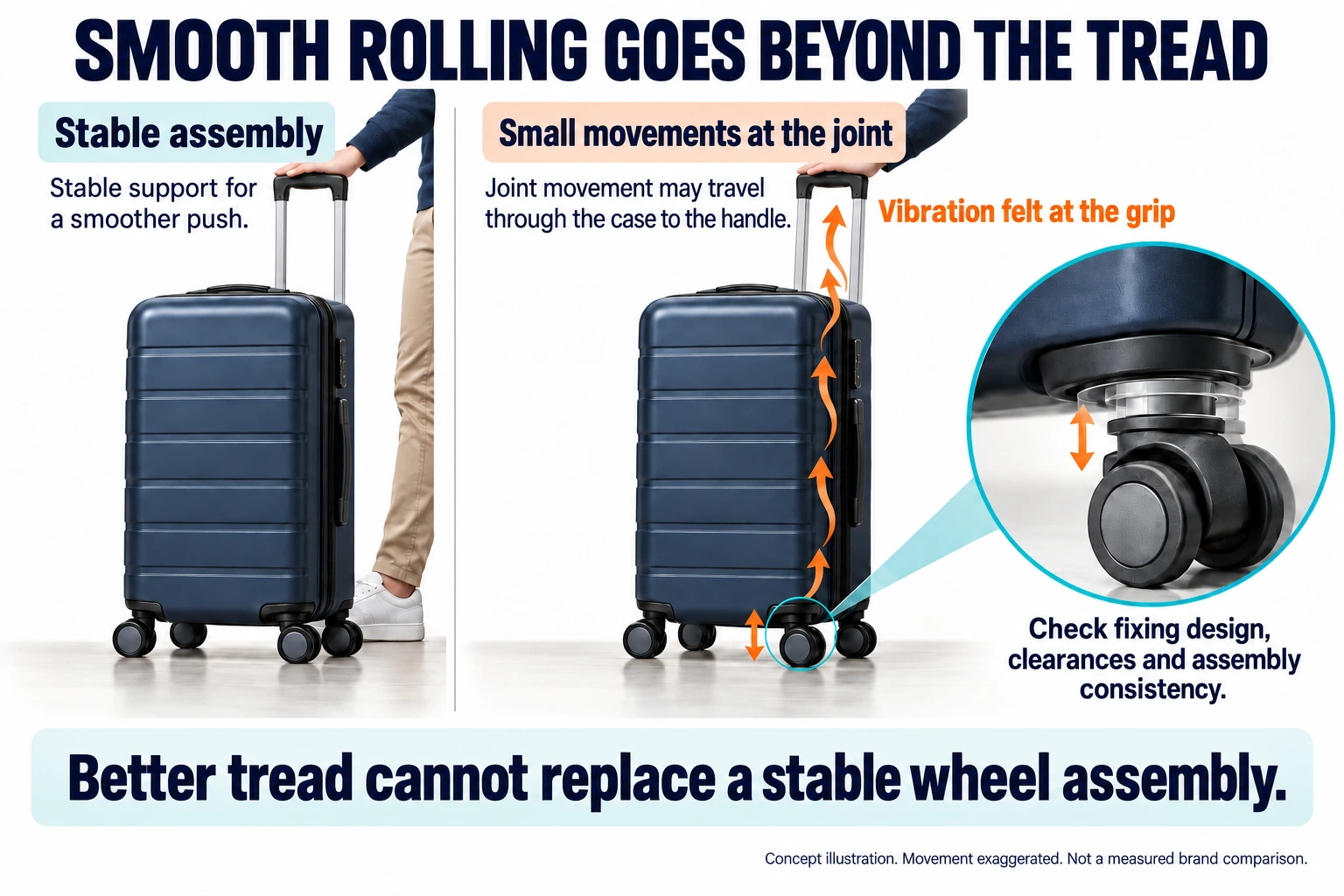
Spinning a detached wheel by hand cannot reproduce all these conditions. Neither can listening to rolling noise alone. A quiet wheel is not automatically a smooth wheel, and a freely spinning wheel does not establish the performance of the loaded suitcase.
Why a material upgrade can miss the problem
Tread material remains important. Its interaction with the floor, deformation and damping behaviour can affect the rolling experience. But it cannot be assumed to compensate for unwanted movement elsewhere in the assembly.
If the limiting factor is a connection, alignment or mounting issue, further spending on the tread may deliver little benefit.
This is a familiar development trap: the easiest specification to compare becomes the explanation for the whole product. Material grade, hardness and unit price fit neatly into a quotation table. Joint movement, assembly consistency and behaviour under load require a more deliberate investigation.
Higher cost becomes useful only when it addresses a demonstrated limitation.
A practical evaluation plan
For sourcing and development teams, I would assess three levels together:
| Level | What to examine |
|---|---|
| Wheel | Finished tread geometry, runout, material condition and rotation |
| Complete assembly | Axial play, rocking, swivel behaviour, retention and consistency between samples |
| Finished suitcase | Loaded straight-line rolling, turning, directional stability and feedback through the handle |
Keep the comparison conditions consistent: case construction, mounting method, load and load distribution, floor surface, trolley extension and pushing speed.
Where possible, swap wheel sets onto the same case, repeat the evaluation across several assemblies and avoid telling evaluators which supplier they are testing.
If the perceived difference is repeatable, investigate it further. Measure joint movement under defined loads and, where suitable equipment is available, compare vibration at the handle. These checks can help connect the subjective impression with physical behaviour.
Evaluate after representative durability testing as well. The assembly needs to maintain its fit and rolling behaviour beyond the first demonstration.
What buyers should ask suppliers
A productive supplier review goes beyond “Which tread material are you using?” Ask:
- How are the metal and plastic elements retained?
- What movement is intended, and what movement is considered unacceptable?
- How are critical dimensions and assembly conditions controlled?
- What happens to play and rolling behaviour after durability testing?
- How does the supplier verify consistency across production?
These questions turn a discussion about a premium material into a discussion about a repeatable product.
The customer feels the assembly
Consumers will not dismantle a wheel housing to inspect its fixing arrangement. They will feel the result each time they push the case.
The lesson from these comparisons is to widen the investigation before increasing the material budget. Wheel geometry, connection stability, assembly tolerances and the finished case all deserve attention.
Smooth rolling is a system outcome. The tread is one contributor—not the whole explanation.
Related reading: More Test Cycles Do Not Always Mean Better Quality · Six Specs That Decide Whether Your Bag Comes Back
Discuss a wheel performance or component validation question with CarryOrigin →