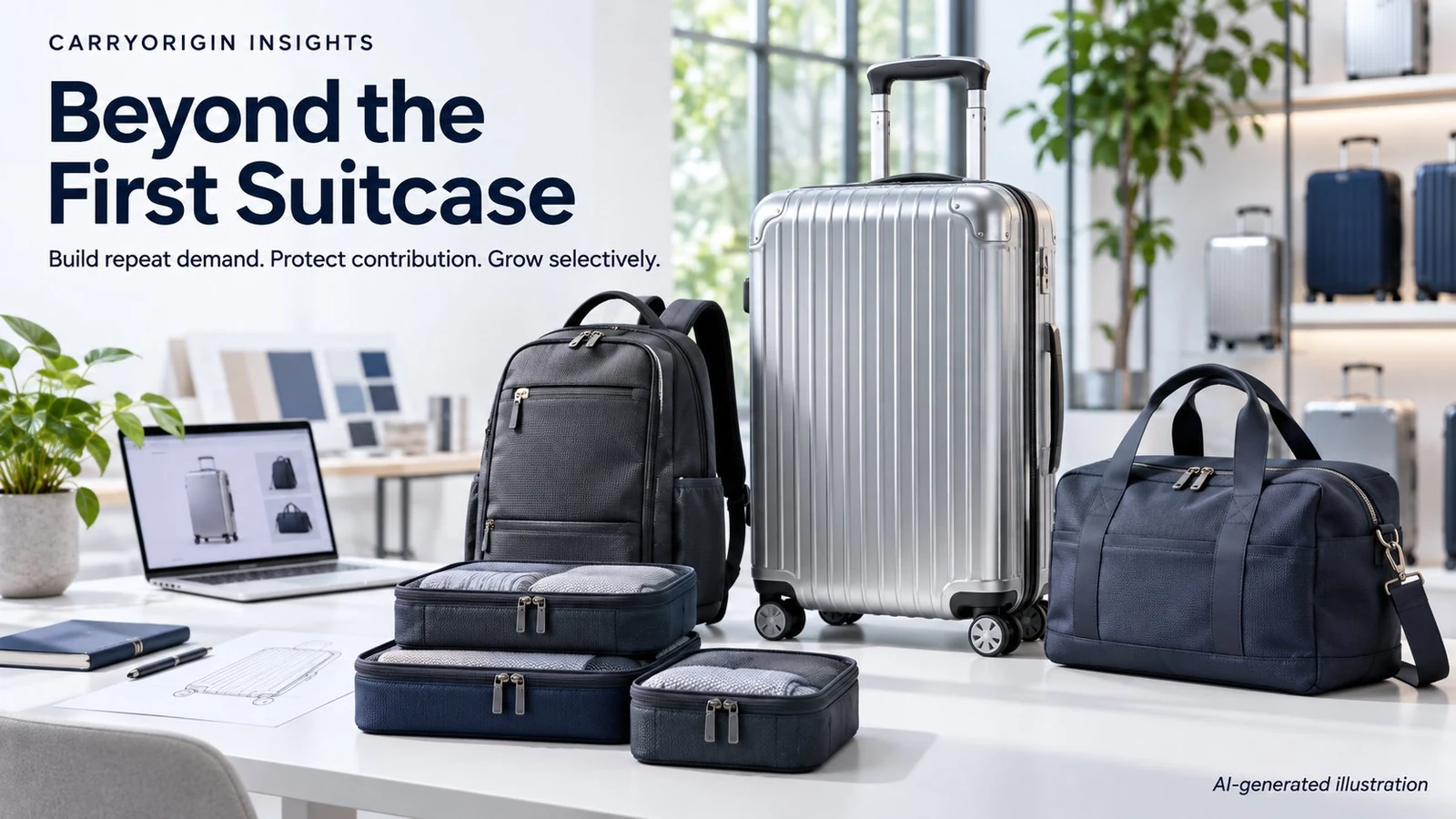
A well-designed suitcase can help launch a brand. It cannot, by itself, sustain the business.
That tension sits at the center of the next chapter for direct-to-consumer luggage. A durable product gives customers a reason to trust you, but also reduces their need to replace it. New colors create interest, but multiply inventory. Wholesale opens another route to customers, while introducing a different margin structure and new operational requirements.
Recent moves by Away, Monos, BÉIS, Antler and Paravel show how brands are responding. They are expanding channels, developing adjacent categories and combining brand equity with larger operating platforms.
For founders, these developments offer practical lessons—and several reasons to grow selectively.
1. Treat DTC as a customer relationship, not a channel restriction
Away's leadership has described its evolving approach as “DTC smart,” with wholesale partnerships becoming part of the business alongside direct sales. Monos has also invested in physical retail, opening five US stores over the year preceding its October 2026 management interview. Away leadership interview, Monos leadership interview
These moves make sense for a product customers often want to touch, roll, lift and pack before buying.
They do not establish that every emerging brand should open stores or pursue wholesale. Each channel changes the economics of the business.
A wholesale order may look attractive until the brand accounts for packaging changes, retailer requirements, promotional allowances, returns and payment timing. A store can improve product discovery while adding rent, staffing and another pool of inventory.
The founder's question is whether the new channel creates profitable access to customers the business can serve well.
Before expanding, build a channel-level contribution model. Include acquisition or selling costs, fulfillment, returns, service and working capital—not just product gross margin.
Then test the channel at a scale that leaves room to learn.
2. Build repeat purchases around customer needs
Luggage brands have a replacement-cycle problem: customers who buy a suitcase that lasts may not need another one for years.
Adjacent products offer one route to growth. Reporting by Glossy, citing Circana, found that US travel-goods dollar sales declined 2% while unit sales increased 1% in the 12 months ending April 2026. Travel accessories accounted for roughly 85% of unit growth, while backpacks also grew. These figures cover the broader US travel-goods market, not DTC brands alone. Glossy industry analysis
The opportunity is to solve another problem for the same customer.
A customer who trusts your carry-on may also need a commuting backpack, a weekender or packing organizers. But a matching color is not enough to justify a new category.
Ask:
- Does the product address a need customers have already expressed?
- Can the brand explain its advantage beyond visual coordination?
- Will the expected contribution cover development, inventory and service?
- Can the team support another category without disrupting the core range?
Start with one clear adjacency. Measure attachment, standalone demand, returns and contribution before adding more.
A larger catalog is useful when it strengthens the customer relationship and the economics together.
3. Your core products deserve more attention than your launch calendar
Paravel's October 2026 relaunch provides a useful counterpoint to constant assortment expansion.
Under its new ownership, the brand returned with a deliberately focused range built around established products. Management also emphasized shared supply-chain, warehousing and logistics capabilities. The relaunch strategy is public; its eventual commercial success remains unproven. Paravel management interview
For an early-stage founder, the lesson is to understand what deserves replenishment.
Identify the products that:
- Sell repeatedly without depending on deep discounts.
- Generate manageable return and warranty costs.
- Have predictable production and replenishment requirements.
- Leave a worthwhile contribution after fulfillment and marketing.
Protect availability on those products before committing cash to a broad seasonal collection.
A modest range with reliable replenishment can serve a young brand better than a larger range with frequent stockouts and slow-moving variants.
4. Brand equity needs an operating system behind it
Samsonite completed its acquisition of BÉIS in October 2026. The announced agreement involved acquiring 85% of the business for $178.5 million, at an enterprise value of approximately $210 million, subject to specified adjustments. Transaction disclosure, Completion announcement
One transaction does not prove that consolidation will determine the entire category. It does illustrate how a digitally built brand can become part of a broader operating platform.
An independent founder does not need to reproduce a global group. But the business does need clear ownership of the work behind the brand:
Demand planning. Product specifications. Supplier quality. Inventory allocation. Fulfillment. Customer service. Repairs.
When those responsibilities are unclear, growth tends to expose the gaps.
Document them while the company is still small. A supplier should know which specification is approved. Customer service should know what the warranty covers. The inventory plan should distinguish a forecast from a committed order.
5. Make the premium visible—and deliverable
Lower-priced competitors give customers more ways to compare.
Quince, for example, lists a front-pocket carry-on at $169.90. That price is a reference point, not proof that competing products have equivalent construction, performance or service. Quince luggage range
For a premium founder, the response should begin with a specific explanation of value.
“Premium materials” is too vague on its own. Explain the product decisions customers can experience: how the bag carries, how the wheels behave, how the interior works, what fits and what happens if a component fails.
Then make sure those decisions survive production.
A useful specification should define the actual configuration, approved materials and components, dimensions, weight, finish and acceptance requirements. Changes should be recorded and approved.
The premium customers pay for must be present in the delivered product, not only in the campaign.
6. Design the warranty before promising it
Repairability and long-term support can strengthen customer confidence. They also create obligations that remain after the sale.
Horizn Studios publishes lifetime warranty coverage for specified luggage ranges, with different terms applying to other products. Founders should read such promises as operating commitments, not simply marketing language. Horizn Studios warranty information
Before making your own commitment, decide:
- Which failures are covered?
- Which components can be replaced?
- Who stocks the parts and performs the repair?
- Who pays for labor and shipping?
- How will replacement parts remain compatible as the product evolves?
Apply the same discipline to recycled-material claims. Specify which component contains recycled material and maintain documentation appropriate to the claim and destination market.
Clear, supportable promises are more useful than broad language the business cannot consistently fulfill.
7. Choose a manufacturing partner for the next order, too
The first sample matters. Reproducing it reliably matters just as much.
For a DTC startup, supplier evaluation should include repeatability, replenishment and problem-solving—not only the initial quote.
Discuss minimum quantities by color and size, sample approval stages, material availability, component substitutions, inspection requirements and spare parts.
Make dedicated inventory explicit. If a custom fabric or finish remains unused, who owns it? If demand arrives below forecast, what can be deferred? If a component changes, who approves the replacement?
These conversations can feel premature before launch. They are harder once cash is tied up and customers are waiting.
A productive manufacturing relationship gives both sides a shared definition of the product, the schedule and the responsibilities.
A practical agenda for founders
Before the next major launch or channel expansion, answer five questions:
- Which product has earned the right to be replenished?
- Which customer need justifies the next category?
- Which channel adds contribution after its full operating costs?
- Which product and service promises can we consistently deliver?
- How much cash is committed before the next customer payment arrives?
The brands competing in luggage today are testing different answers. Their announcements are useful signals, but they are not substitutes for your own unit economics and customer evidence.
Build the next stage around a product customers value, a supply chain that can reproduce it and a business that can afford to support it.
Research note: This article reflects publicly available information reviewed through November 10, 2026. It examines selected brands competing in European and North American markets, including brands headquartered elsewhere. Private-company disclosures and management interviews are not equivalent to audited financial results. No market-share ranking or category-wide profitability conclusion is implied.
Discuss your project with CarryOrigin
Related: Finding the Right Luggage Supplier Takes More Than a Supplier List